Artificial Intelligence and Data: A Data Engineer’s Perspective
Behind every smart AI answer stands one thing: data. And the data engineers who know how to make it work

Originally published on Medium → read here
Introduction
Right now, we’re standing at a turning point in how new technologies shape business. AI is no longer a toy or an experiment for enthusiasts. ChatGPT and similar tools have already moved far beyond being just “meme generators” — they’re becoming real business tools.
Today, it’s almost impossible to find a company whose website or pitch doesn’t mention AI and how it supposedly helps them. But behind all the shiny examples lies the real foundation: data.
As a data engineer, I’ve gotten used to regularly rethinking technologies and practices: what has already become the standard, what is fading away, and what opens up new horizons. And right now, I have a strong feeling: we’re standing on the edge of a new role for data engineers — becoming the bridge between AI and business, through data management.
AI for Value, Not for Hype
Implementing AI “just because it’s trendy” makes no sense. Its real value shows up only when it solves concrete problems: speeds up access to information (question → answer), helps make better decisions, unlocks new opportunities, improves efficiency.
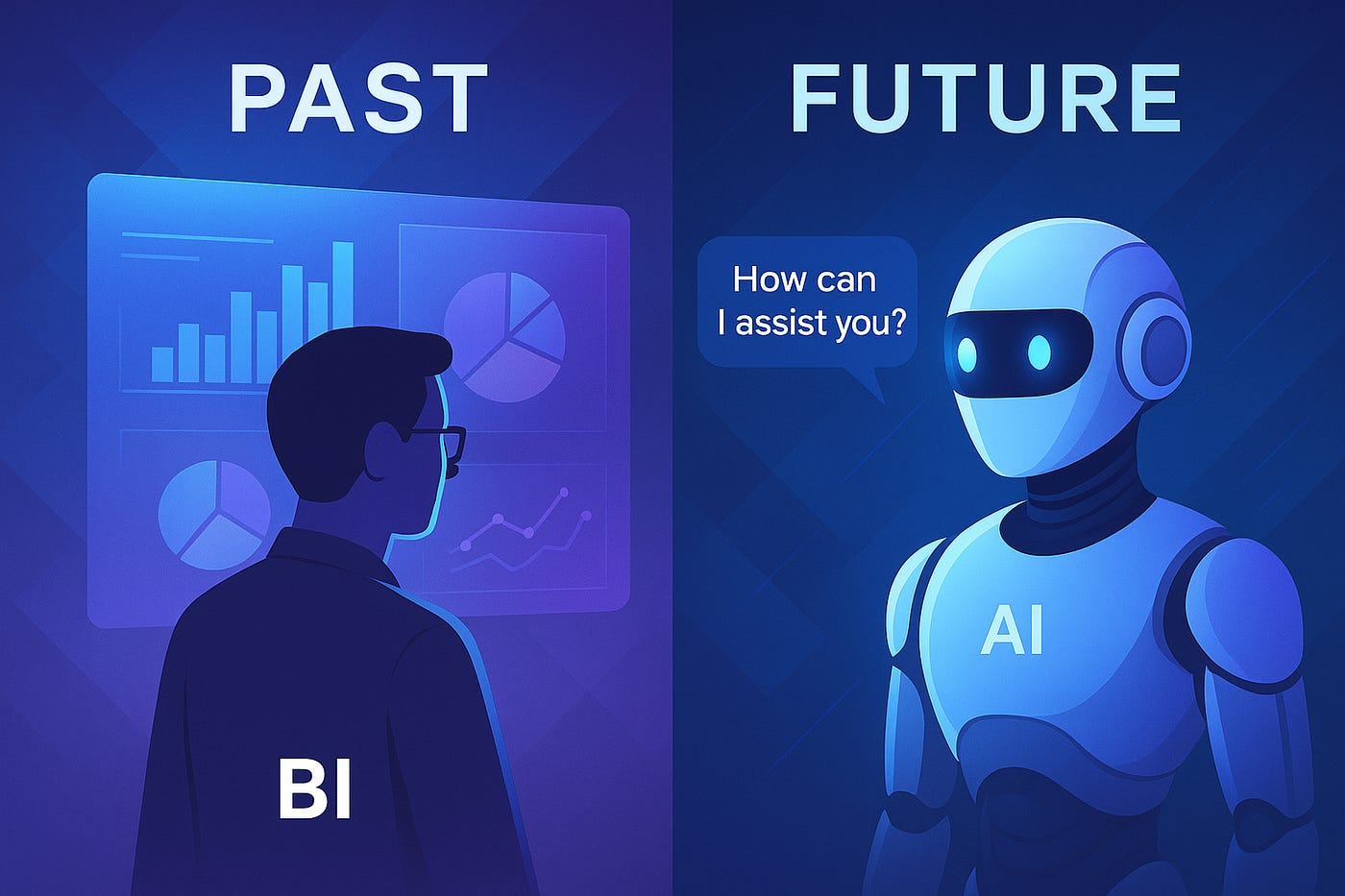
Take BI systems, for example. Today they’re overloaded with charts and complex queries. Sometimes they look more like a spaceship control panel than a decision-making tool. A skilled analyst can handle it — they know the database structure, write SQL, filter results. But the real goal is different: to make valuable insights accessible to everyone.
AI reduces it all to a simple dialogue: one question — one answer.
But behind this simplicity hides complex engineering: data infrastructure, query optimization for specific databases, modeling, and data relationships. In fact, these are the same challenges we’ve always solved in traditional systems — only now, in a completely new environment.
The New Cognitive Complexity
AI systems create another challenge — cognitive complexity.
How can a human truly understand an architecture where dozens of microservices, data platforms, orchestrators, and AI models are tightly connected? How rare are the specialists who can actually grasp the whole picture? How do we even measure their competence and value?
This is not “routine work.” It’s a unique skill. Maybe one day it will become the norm, but today it’s expensive, difficult, and accessible to very few.
And there’s also a human side: how long can an engineer carry this load without burning out or simply walking away? That’s still an open question.
One thing is clear: building systems with AI is full of new challenges and demands new approaches. For now, it’s still humans who can handle this complexity.
Who Will Win the Race?
The first leaders in their industries won’t be the ones who “cut costs with AI.” They’ll be the ones who discover growth opportunities with this powerful new tool.
Here, a metaphor comes to mind: during the gold rush, the winners weren’t those who fired the miners — but those who actually found the gold vein.
Examples:
Retail: thousands of SKUs, hundreds of stores, complex supply chains, warehouse optimization. Today all this translates into dozens of reports. AI won’t magically solve everything. But imagine a simple chat interface hiding a complex system that has access to data and metadata — and can instantly answer questions that once required hours of analysis.
Other industries: medicine, finance, science — each has its own “gold veins” waiting to be discovered.
Yes, custom software development will stay. But the very way we interact with data is already changing.
And the bigger question is: how many hidden opportunities are still waiting inside this young understanding of AI?
The Role of Data Engineers
And here comes a new challenge. Many companies still don’t even have a proper data platform. They continue to rely on old approaches to data — and often for a reason: those approaches still “work”.
But times are changing. There is no universal “perfect” platform, no single orchestrator, no ideal storage format. What’s clear is this: data and the way we manage it have become a prerequisite for adopting AI.
The data engineer of the future is no longer just an ETL specialist, a DWH engineer, or a YAML wizard. They are the ones who build the bridge between chaotic data and AI systems, so that businesses can rely on a solid foundation.
This work is not about just setting up pipelines. It’s about mature data management: validating and ensuring quality, choosing the right formats and databases, modeling and documenting data, integrating diverse components into a single ecosystem.
And this is the real shift. If earlier data engineers were often seen as “technical executors”, now they are becoming strategic players. Their decisions determine not only the speed of data pipelines, but also whether a company can build AI systems that truly deliver results.
Conclusion
AI is changing not only interfaces and the way we interact with systems, but the very logic of working with data. Companies that learn to apply it correctly — not just to automate, but to rethink processes — will set the new standard and take the lead in their industries.
But for that to happen, a foundation is needed. And that foundation is data. Without it, AI is just a beautiful storefront with empty shelves.
This is where the new role of the data engineer comes to life. No longer just a “technical executor,” but a strategic player who connects data and AI. Their choices will define whether companies merely play with trendy technologies — or build systems that actually generate value.
What do you think: will data engineers become the key figures in AI teams, or will someone — or something — else take that role?